Since beginning her work with the Chinese Medical Team Assisting Cambodia, Dr. Zhang Xuemei from our hospital has persisted in balancing clinical practice and teaching. By day, she diagnoses patients and prescribes treatments; by night, she prepares materials and lesson plans. Through formulas, acupuncture, and ear acupressure beans, she has planted the seeds of TCM's "preventive treatment" philosophy along the banks of the Mekong River while steadily strengthening the pulse of Sino-Cambodian friendship. Today, let us follow Dr. Zhang Xuemei's perspective to experience the daily life of a medical aid doctor.
In just two months, our eight-member TCM team to Cambodia has etched the words "Chinese Traditional Medicine" deeply into this land. On one hand, we continue to treat patients; on the other, we focus on education and dissemination.
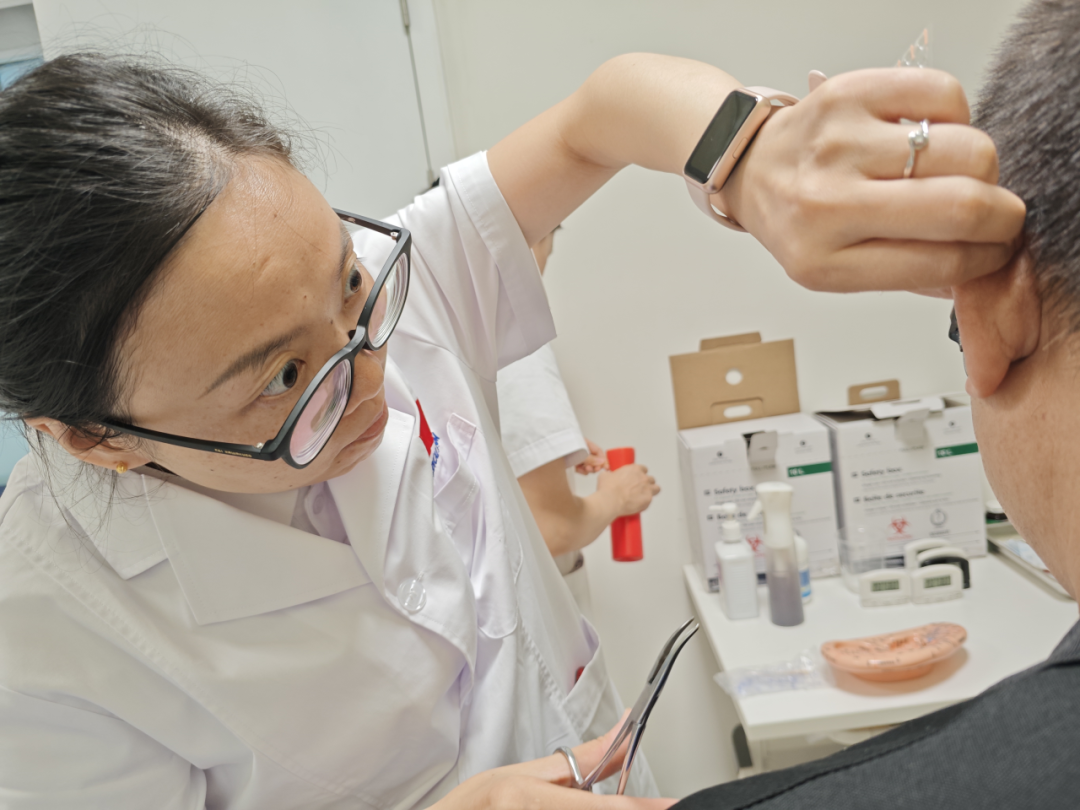
Zhang Xuemei applies ear acupressure for patients
In clinical practice, we discovered that insomnia is a "common enemy" for Cambodian youths, middle-aged, and elderly alike. When treating such patients, I implement syndrome differentiation and tailored therapies while also incorporating ear acupressure bean therapy. By targeting the heart, Shenmen, subcortex, and sympathetic points, and adjusting with liver, spleen, and kidney points as needed, I affix cowherb seeds onto 0.6×0.6 cm ear beans and teach patients to "press three times daily, once per breath." For instance, 30-year-old Mr. Wang, a local entrepreneur, has seen his nightly sleep increase from five to seven hours. He now falls asleep faster and experiences deeper sleep. Patients often smile and call the "Chinese bean" a "magic bean," but we know that within each tiny bean lies the millennia-old wisdom of TCM encapsulated in the principle that "the ears gather all meridians."
The consultation room also serves as a classroom. After clinic hours, the room welcomes three Cambodian students passionate about TCM. We use our spare time to teach them foundational theories of TCM, explaining concepts like yin and yang and the five elements' interactions, aiming to leave behind a lasting TCM legacy. On September 12, when the Confucius Institute at the Royal Academy of Cambodia welcomed a new group of teachers, I was invited to participate in their pre-service training. I delivered a lecture titled "Health Maintenance and Disease Prevention in Cambodia," covering topics from dengue fever to occupational ailments among educators. I explained health preservation insights from the Yellow Emperor’s Inner Canon and demonstrated hands-on techniques such as massaging the Shenmen point, stimulating the Lianquan point, and patting the Danzhong point, encouraging teachers to integrate TCM wellness wisdom into their daily lives.
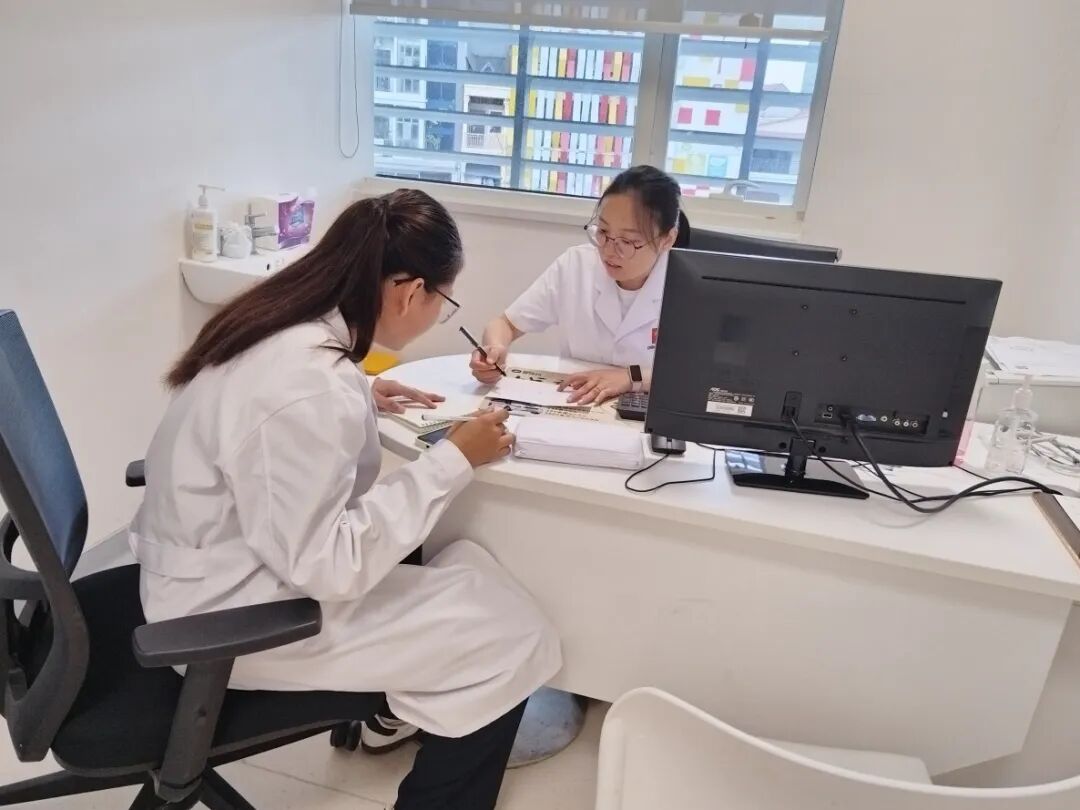
Zhang Xuemei explains the basic theory of Traditional Chinese Medicine to interns
The TCM clinic is not only a base for medical practice and teaching but also a hub for spreading TCM culture. Those tiny beans affixed to ears and notes filled with diagrams of the five elements' interactions will shine like starlight over the Mekong River, illuminating Cambodia's path to health for years to come. As for us, we will carry the memories of this "dual pursuit" forward, continuing to share the story of TCM with the world.
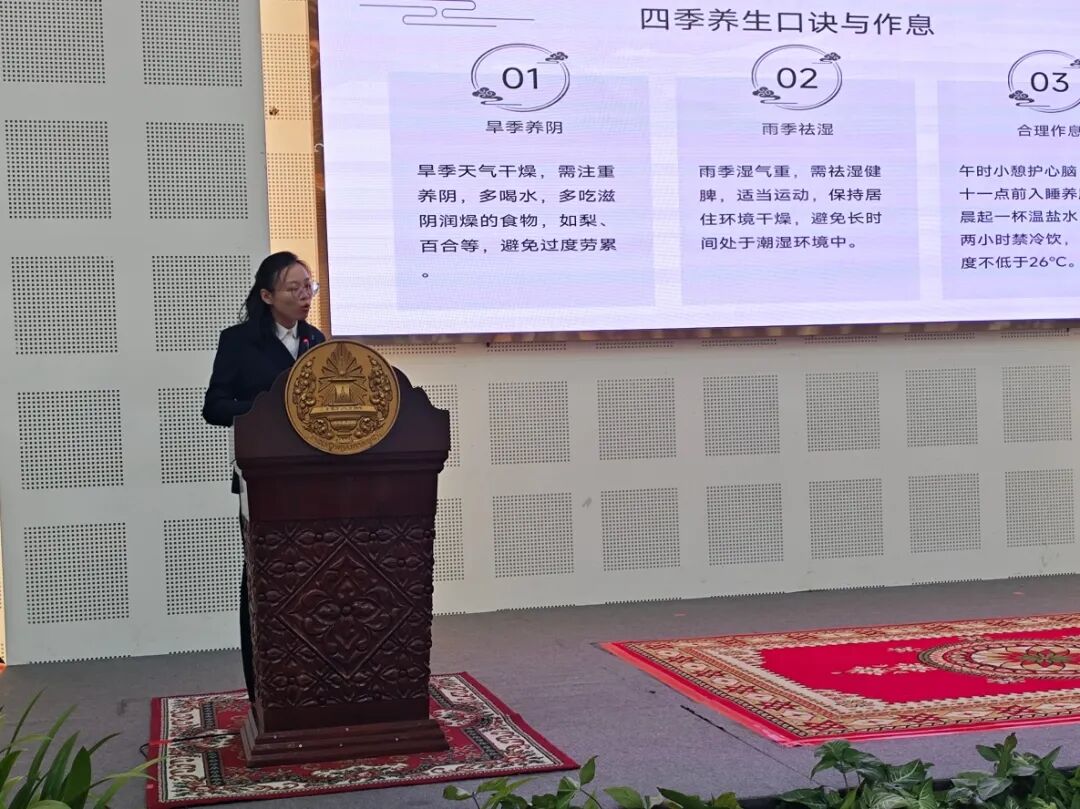
Zhang Xuemei teaches at the Confucius Institute of the Royal Academy of Cambodia